


Fog can make even a familiar road difficult to navigate. On major UAE highways, where traffic often moves at high speeds, a sudden drop in visibility can leave drivers with very little time to react to slowing vehicles, lane changes, or unexpected obstacles.
Foggy conditions are particularly common during the early morning, often affecting roads in Dubai, Abu Dhabi, and other parts of the UAE. Visibility can also vary considerably during the same journey. One section of road may be relatively clear, while the next is covered in dense fog.
The most important thing to remember when driving in fog is that your speed, following distance, and driving behavior must match what you can actually see ahead. Here is how to manage reduced visibility safely.

Why Is Driving in Fog Dangerous?
Fog consists of tiny water droplets suspended in the air, which scatter light and make distant objects harder to distinguish. For drivers, this affects more than simply seeing the road ahead.
It becomes harder to judge how far away another vehicle is, recognize when traffic is slowing, or identify an approaching exit. Road signs and lane markings may only become visible when you are already close to them.
The risk is particularly serious on highways because stopping distance increases with speed. A vehicle traveling at 120 km/h covers approximately 33 meters every second. If visibility drops to just a few dozen meters, a driver may not have enough distance to react and stop before reaching an obstacle.
This is why slowing down early is so important. By the time you see a hazard through dense fog, braking may not be enough to avoid it.
Reduce Your Speed According to Visibility
One of the most important rules for driving in fog in the UAE is to reduce your speed gradually as visibility decreases.
A highway may normally have a speed limit of 100 or 120 km/h, but that does not mean either speed is safe in foggy conditions. The appropriate speed depends on how far ahead you can see, the traffic around you, and whether you have enough distance to stop safely.
Avoid suddenly pressing the brakes when you encounter a foggy section. Instead, release the accelerator and reduce your speed progressively while checking surrounding traffic.
Be equally careful when visibility begins to improve. Fog often develops in patches, so accelerating immediately after passing through a clearer section can leave you traveling too fast when the next dense patch appears.
What Is the Speed Limit During Fog in Abu Dhabi?
Abu Dhabi uses variable speed limits on certain roads during hazardous weather conditions.
When authorities activate the fog speed reduction system, the permitted speed on affected roads can be lowered to 80 km/h, even if the normal posted limit is higher.
Drivers must follow the temporary speed limits displayed on electronic road signs and official traffic alerts. These limits can be enforced through speed cameras.
However, 80 km/h is not a general fog speed limit across the entire UAE, nor is it necessarily safe in every situation. If visibility is particularly poor, drivers should reduce their speed further.
Use Low-Beam Headlights and Fog Lights Correctly
It might seem logical to use your brightest headlights when visibility is poor, but high beams can actually make fog more difficult to see through.
High-beam headlights direct stronger light farther ahead. In fog, much of that light reflects off suspended water droplets and scatters back toward the driver, creating glare.
Low-beam headlights are more suitable because they direct light downward and provide better illumination of the road immediately ahead.
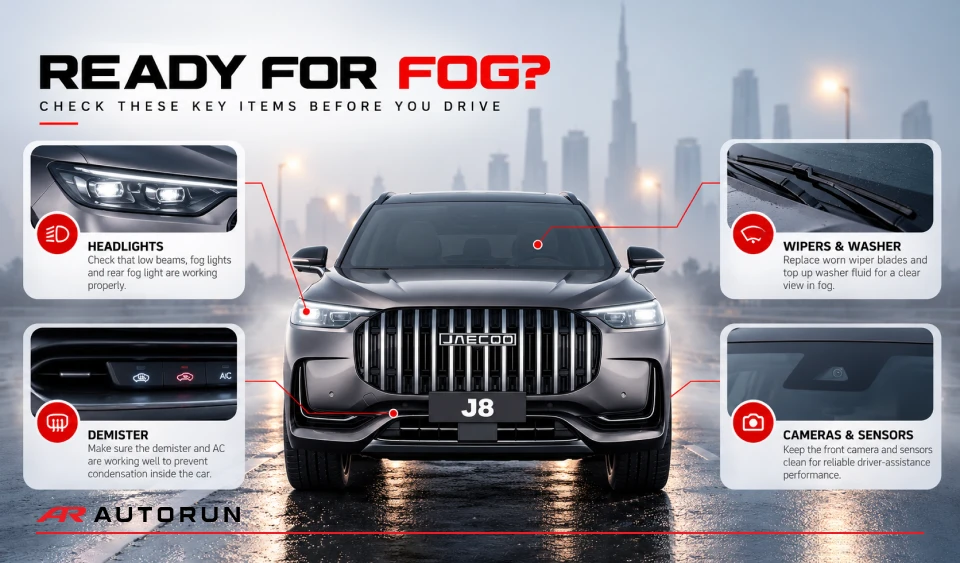
If your vehicle is equipped with front fog lights, they can provide additional illumination closer to the road surface. Rear fog lights, where fitted, help other drivers notice your vehicle in severely reduced visibility.
Keep these points in mind:
- Switch on your low-beam headlights when visibility decreases.
- Use dedicated fog lights when conditions require them.
- Avoid high beams because they can increase glare.
- Do not rely entirely on automatic headlights, which may remain off in bright but foggy conditions.
- Turn off fog lights when visibility improves to avoid dazzling other drivers.
Using the correct lighting is about being seen as much as seeing the road yourself.

Maintain a Greater Distance from Other Vehicles
Following distance becomes especially important when driving through fog.
On a clear road, drivers can usually identify slowing traffic from a considerable distance. In dense fog, brake lights may only become visible when the vehicle ahead is already close.
Maintaining your usual following distance therefore leaves less room to react.
A practical approach is to increase the gap well beyond what you would maintain in normal conditions. Abu Dhabi Police has advised drivers to double their usual safe following distance during foggy weather.
For example, if you normally maintain a two-second gap, increasing it to at least four seconds provides more reaction time. Even more space may be necessary when visibility becomes extremely limited.
Avoid following another vehicle closely simply to use its taillights as a guide. The driver ahead may brake unexpectedly, change lanes, or make a mistake.
Instead, concentrate on maintaining a speed and distance that allow you to stop within the stretch of road you can see.
Avoid Unnecessary Lane Changes and Overtaking
Changing lanes in dense fog can be dangerous because it is more difficult to judge the location and speed of vehicles approaching from behind.
A car that appears far away in your mirror may be traveling considerably faster than expected. Similarly, another driver may not notice your vehicle until you have already started moving into their lane.
The safest approach is to remain in your lane whenever possible and avoid unnecessary overtaking.
If you need to change lanes or take an exit, signal early, check your mirrors and blind spots carefully, and move only when you have enough visible space.
Do not make last-minute movements to reach an exit that suddenly appears through the fog. Missing an exit and taking the next available route is safer than attempting a sudden lane change.
Road markings can also help you maintain your position when distant reference points are difficult to see. Focus on staying within your lane rather than following the movements of the vehicle ahead.
Should You Use Hazard Lights While Driving in Fog?
A common mistake on UAE roads is switching on hazard lights while continuing to drive through fog.
Although this might seem like a way to make the vehicle more visible, it can confuse surrounding drivers.
Hazard lights are intended to warn others about an emergency or a stationary vehicle. When used continuously while driving, they make it harder for other motorists to understand your intentions and can interfere with the clear communication of turning or changing lanes.
UAE road safety guidance advises motorists not to use hazard lights while driving normally through fog.
Instead, keep your low-beam headlights on and use your fog lights when appropriate.
If you need to stop because of an emergency, move completely away from moving traffic wherever safely possible. Once the vehicle is safely stationary, activate the hazard lights to warn approaching drivers.
Never stop suddenly in an active traffic lane because visibility has deteriorated.
Keep Your Windscreen and Mirrors Clear
Reduced visibility outside the vehicle is already challenging, but condensation and dirty glass can make the situation considerably worse.
Foggy weather may cause moisture to build up on the windscreen or windows, particularly when the temperature outside differs from the temperature inside the cabin.
If condensation appears, use the vehicle’s front windscreen demister or defogger. The air-conditioning system can help remove moisture from the cabin air, while the rear window defogger can clear condensation from the back glass.
Windscreen wipers may also be necessary when moisture gathers on the exterior surface.
Before driving in foggy conditions, check that the windscreen, mirrors, headlights, and taillights are clean. Ensure your wipers work properly and that the washer fluid is sufficient.
These simple checks can make it easier to identify vehicles, lane markings, and other hazards through already limited visibility.
Can You Rely on Driver-Assistance Systems in Fog?
Many modern vehicles offer driver-assistance features designed to support everyday driving, including Adaptive Cruise Control (ACC), Lane Keep Assist (LKA), and Automatic Emergency Braking (AEB).
However, these technologies are not substitutes for careful driving when visibility is limited.
Adaptive Cruise Control uses radar, cameras, or a combination of sensors to monitor traffic ahead and adjust vehicle speed. Depending on the system, dense fog or moisture may interfere with its ability to detect certain objects accurately.
Lane Keep Assist also depends on recognizing lane markings, usually through a forward-facing camera. When fog makes those markings difficult to identify, the system may provide limited assistance or become unavailable.
Some vehicles warn the driver when their sensors cannot operate properly, but the absence of a warning does not guarantee that the technology will perform normally in poor visibility.
For this reason, avoid relying on cruise control in dense fog and follow the manufacturer’s instructions for using driver-assistance features in adverse weather.
You can learn more about the capabilities and limitations of these systems in our guides to Adaptive Cruise Control and Lane Keep Assist.
Check Weather and Traffic Alerts Before Driving
Fog can develop overnight and remain present during the morning commute, particularly on roads outside densely built-up areas.
Before beginning a journey, check the latest weather forecasts and visibility warnings issued by the UAE’s National Center of Meteorology.
Traffic alerts from Dubai Police, Abu Dhabi Police, and other relevant authorities can also provide information about affected roads, temporary speed restrictions, and traffic conditions.
This is particularly useful when traveling between emirates, where visibility may change significantly along the route.
If a warning indicates extremely poor visibility and your journey is not essential, postponing your departure may be the safest decision.
If you must travel, allow extra time and plan for slower traffic. Rushing to make up for a delayed departure can encourage unnecessary speeding and overtaking when the conditions require greater caution.
What Should You Do If Visibility Becomes Too Poor to Continue?
Sometimes fog becomes so dense that continuing to drive is no longer safe, even at a reduced speed.
If you reach this point, do not brake abruptly or stop in the middle of the road. Reduce your speed smoothly and look for a safe place to leave the carriageway.
Whenever possible, use a designated parking area, petrol station, or suitable exit where you can stop completely away from passing traffic.
Avoid stopping on a highway shoulder unless absolutely necessary, as approaching drivers may not notice your stationary vehicle in time.
Once you have reached a safe stopping location, activate your hazard lights if necessary and wait until visibility improves.
The important distinction is between stopping safely away from traffic and stopping directly in the path of other vehicles. In dense fog, a stationary car on an active road can become a serious collision hazard.

Final Thoughts
Driving in fog in the UAE requires more than simply switching on your headlights. Reduced visibility changes how much time you have to respond to traffic, making speed control, following distance, and predictable driving particularly important.
Whether you’re commuting through Dubai or traveling on a highway between emirates, adjust your speed to what you can see, avoid unnecessary lane changes, and stay alert to changing road conditions.
If visibility becomes too poor to continue safely, find a suitable place to stop rather than taking unnecessary risks.
A slower journey is always preferable to a collision caused by driving beyond the limits of visibility.
Frequently Asked Questions About Driving in Fog in the UAE
What headlights should I use when driving in fog?
Use low-beam headlights and dedicated fog lights when available and appropriate. Avoid high-beam headlights because their light reflects off water droplets in the fog, increasing glare and reducing visibility.
Is it illegal to drive with hazard lights on in fog in the UAE?
UAE authorities advise drivers not to use hazard lights while driving normally in fog. Hazard lights are intended for emergencies and stationary vehicles. Drivers should use their regular headlights and appropriate fog lights instead.
What is the maximum speed during fog in Abu Dhabi?
On affected roads, Abu Dhabi authorities may temporarily reduce speed limits to 80 km/h during foggy conditions. Drivers must follow the displayed temporary limits and reduce speed further whenever visibility requires it.
Is Adaptive Cruise Control safe to use in dense fog?
Adaptive Cruise Control may be affected by poor visibility or sensor limitations, depending on the vehicle. It is generally advisable to avoid relying on cruise control in dense fog and to follow the manufacturer’s instructions for adverse weather conditions.
What should I do if fog suddenly becomes very dense?
Reduce speed gradually, maintain a greater distance from surrounding traffic, and avoid sudden maneuvers. If visibility becomes too poor to continue safely, find a suitable place to stop completely away from moving traffic.
