


Adaptive Cruise Control and Traffic Jam Assist are both designed to make driving easier, but they are useful in different situations.
The simple difference is this: Adaptive Cruise Control is mainly useful when traffic is moving, while Traffic Jam Assist is designed for slow, stop-and-go traffic.
For Dubai drivers who regularly deal with both highway driving and congestion, here is how the two systems differ in everyday use.
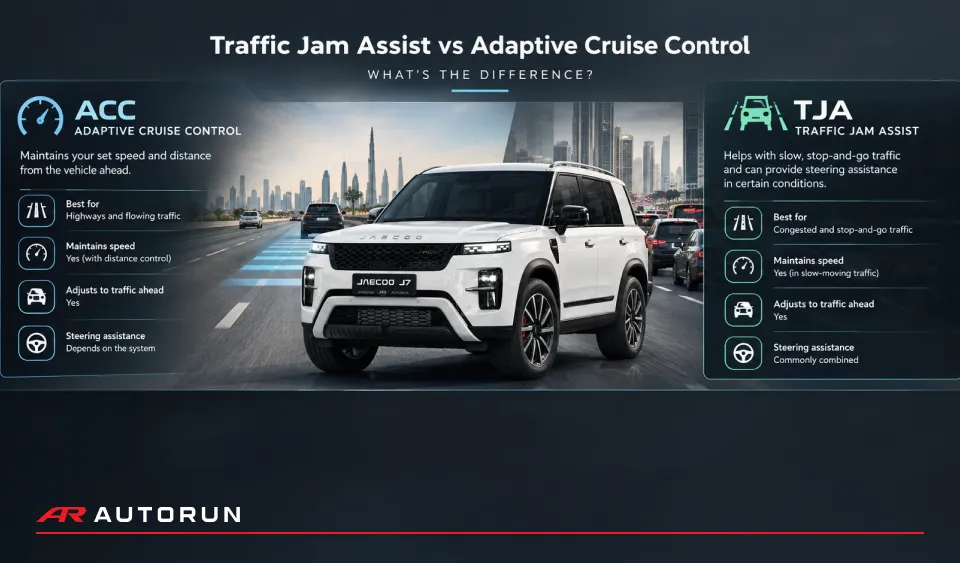

What Does Adaptive Cruise Control Do?
Adaptive Cruise Control, or ACC, maintains a set speed while also monitoring the vehicle ahead.
For example, imagine you are driving on Sheikh Zayed Road at 100 km/h. If the car ahead slows down, ACC can automatically reduce your speed to maintain a suitable following distance. When traffic clears, the vehicle can accelerate back toward your selected speed.
This makes ACC particularly useful for:
- Highway driving
- Longer commutes
- Roads where traffic speed changes frequently
- Reducing constant accelerator and brake adjustments
Unlike conventional cruise control, you do not have to cancel the system every time the vehicle in front slows slightly.
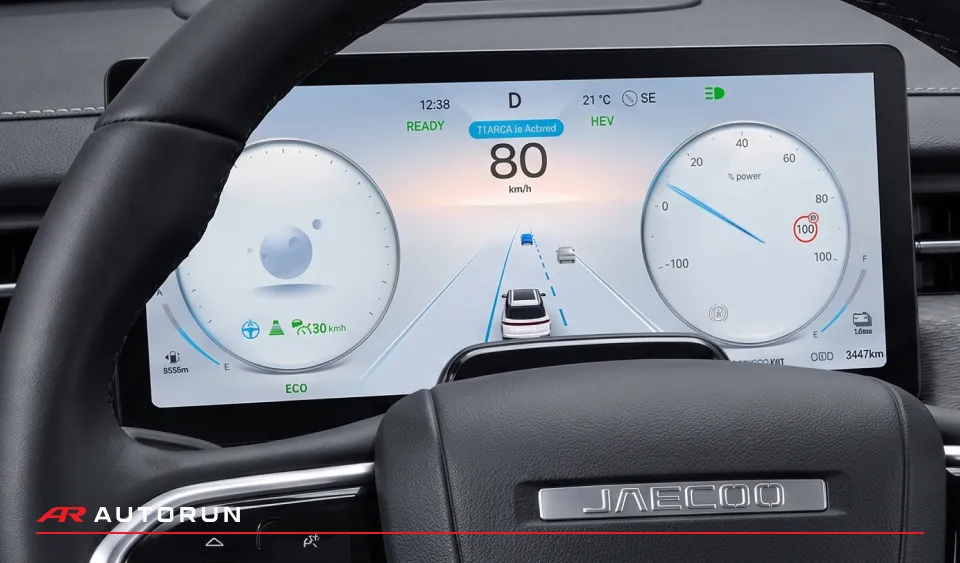
What Does Traffic Jam Assist Do?
Traffic Jam Assist, or TJA, is intended for much slower traffic.
Think about a busy evening commute where traffic moves a few metres, stops, then starts moving again.
Depending on the vehicle, Traffic Jam Assist can work with systems such as adaptive cruise control and lane assistance to help manage speed, distance and steering at lower speeds.
In practical terms, it can reduce some of the repetitive work involved in:
accelerate → brake → stop → move → brake again
That is where TJA becomes most useful.
Traffic Jam Assist vs Adaptive Cruise Control
| Adaptive Cruise Control | Traffic Jam Assist | |
|---|---|---|
| Best for | Moving traffic and highways | Slow and stop-and-go traffic |
| Controls speed | Yes | Yes |
| Maintains distance from traffic ahead | Yes | Yes |
| Steering assistance | Depends on the vehicle | Often included as part of the system |
| Typical use | Highway commute | Traffic congestion |
| Driver still needs to pay attention | Yes | Yes |
The systems can also overlap. Traffic Jam Assist often uses several existing driver-assistance functions together rather than operating as one completely separate technology.
A Simple Dubai Example
Imagine your commute starts on Sheikh Mohammed bin Zayed Road.
Traffic is flowing normally, so you activate Adaptive Cruise Control. The vehicle maintains your selected speed and adjusts when cars ahead slow down.
A few kilometres later, traffic becomes heavily congested.
This is the type of situation where Traffic Jam Assist becomes more relevant, helping with the repeated low-speed movements that make congestion tiring.
That difference is more useful to understand than the technical names themselves:
ACC helps with changing traffic speeds. TJA helps with traffic jams.
Does Traffic Jam Assist Drive the Car for You?
No.
Neither Traffic Jam Assist nor Adaptive Cruise Control makes the vehicle fully autonomous.
You still need to watch the road, remain ready to steer or brake and follow the vehicle manufacturer’s instructions for using the system.
Cameras, radar and other sensors can also be affected by road conditions, unclear lane markings, dirt or other environmental factors.
These technologies should therefore be treated as driver assistance, not a replacement for the driver.
Which One Is More Useful in the UAE?
For many UAE drivers, having both types of assistance is more useful than choosing between them.
Adaptive Cruise Control can make longer highway journeys more comfortable, while Traffic Jam Assist is more relevant when the same journey turns into slow-moving congestion.
When comparing a new SUV, it is worth checking exactly which driver-assistance systems are included in the trim you are considering.
For example, the JAECOO J8 offers an Advanced Driver Assistance System that includes Adaptive Cruise Control alongside other driving and safety technologies. Drivers considering electrified options can also explore models such as the JAECOO J7 SHS and compare their available technology and specifications.
You can also browse the complete range of OMODA & JAECOO cars available in Dubai to compare models and trims.
Try the Features During Your Test Drive
ADAS features can sound impressive on a specification sheet, but the best way to understand them is to use them yourself.
During a test drive, check how easy it is to set the following distance, adjust the cruise speed and understand the information shown on the driver’s display.
More importantly, pay attention to how naturally the system responds when traffic ahead slows down.
If driver-assistance technology is an important part of your next car, you can book an OMODA or JAECOO test drive in Dubai with AUTORUN and experience the available features before deciding which model and trim suits you.
