


When comparing cars or SUVs, you will often see FWD and AWD listed in the specifications. The difference affects traction, fuel consumption, purchase cost, and how confidently the vehicle handles different surfaces.
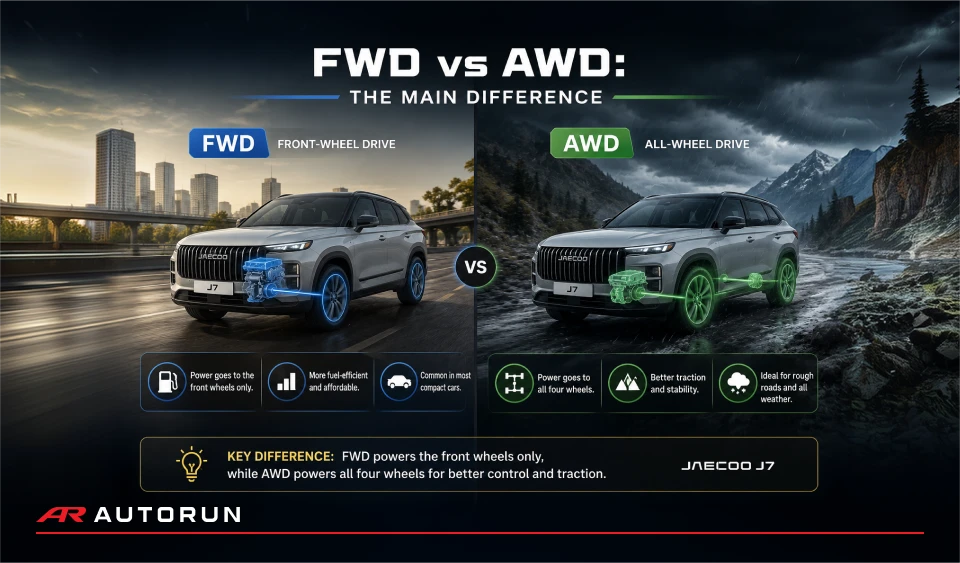
FWD, or Front-Wheel Drive, sends power mainly to the front wheels.
AWD, or All-Wheel Drive, can send power to all four wheels when needed.
Neither system is automatically better. For UAE drivers, the right choice depends on whether you mainly drive in the city or regularly head onto gravel roads, mountain routes, campsites, or other loose surfaces.
FWD vs AWD: Quick Comparison
| Feature | FWD | AWD |
|---|---|---|
| Power Delivery | Front wheels | Can send power to all four wheels |
| Best For | City and highway driving | Mixed surfaces and changing grip |
| Fuel Economy | Usually better | Usually slightly higher consumption |
| Purchase Cost | Usually lower | Usually higher |
| Rain & Loose Surfaces | Good with suitable tyres | Better traction when accelerating |
| Off-Road Use | Limited | Better for light off-road use, depending on the vehicle |

What Is Front-Wheel Drive?
Front-Wheel Drive sends engine power mainly to the front wheels.
Because the drivetrain is generally lighter and simpler than AWD, FWD vehicles can offer better fuel efficiency, lower purchase costs, and simpler maintenance.
For everyday UAE driving on paved roads, FWD is usually more than enough.
It works particularly well for:
- Daily commuting
- School runs
- Mall and city driving
- Highway journeys
- Drivers prioritising fuel economy
For buyers who spend almost all their time on normal roads, paying extra for AWD may not provide much practical benefit.

What Is All-Wheel Drive?
All-Wheel Drive allows the vehicle to send power to both the front and rear wheels.
Some systems continuously power all four wheels, while others mainly operate through one axle and automatically send power to the other when more traction is required.
Modern AWD systems can respond to wheel slip and changing road conditions without requiring much input from the driver.
This makes AWD particularly useful on:
- Wet roads
- Gravel
- Uneven access roads
- Mountain routes
- Loose surfaces
- Light sandy tracks
For SUV buyers who regularly travel beyond paved city roads, AWD can provide useful extra confidence.
Is AWD the Same as 4WD?
No.
AWD is generally designed to improve traction during normal road driving and light off-road conditions. It usually works automatically.
4WD, or Four-Wheel Drive, is more commonly associated with serious off-road vehicles. Depending on the system, it may include low-range gearing, locking differentials, or dedicated terrain settings for more demanding conditions.
For city driving, rain, gravel, and light trails, AWD is usually easier to live with.
For deep sand, dunes, and serious desert driving, a proper 4WD system may be more appropriate.
FWD vs AWD for City Driving
For most city driving in Dubai, Abu Dhabi, or Sharjah, FWD is the more practical choice.
Roads are generally paved, and daily driving involves traffic, parking, commuting, and highway use rather than difficult terrain.
FWD also usually brings:
- Lower fuel consumption
- Lower purchase price
- Less drivetrain complexity
- Lower potential maintenance costs
If your SUV rarely leaves paved roads, FWD can provide everything you need.
FWD vs AWD on UAE Highways
Both systems work well on highways.
During normal dry-road cruising, the advantages of AWD are relatively limited. A good FWD vehicle with quality tyres, stability control, and a well-tuned suspension can feel very stable at highway speeds.
AWD becomes more useful when grip changes, such as during rain or when loose sand has collected near the road edge.
Even then, AWD should not be confused with extra braking ability. It mainly improves traction when accelerating.
FWD vs AWD in Rain
Rain can make UAE roads unexpectedly slippery, particularly when water mixes with accumulated dust and oil.
AWD can help reduce wheelspin when accelerating and distribute power across more wheels.
However, it does not automatically reduce braking distance.
Tyres remain one of the most important safety factors in wet conditions. A FWD vehicle with good tyres can perform better than an AWD SUV running worn tyres.
When driving in rain, reduce speed, increase following distance, and avoid sudden steering or braking inputs regardless of drivetrain.
What About Sand and Gravel?
AWD becomes more useful when driving on gravel roads, rough access tracks, or light sandy surfaces.
By sending power to more than one axle, the system can help the vehicle maintain traction when one or more wheels have less grip.
For camping areas, outdoor destinations, mountain roads, and desert-adjacent tracks, this can be useful.
But AWD does not automatically make an SUV suitable for dune driving.
Deep sand requires more than drivetrain type. Ground clearance, tyres, tyre pressure, cooling, recovery equipment, and driver experience all matter.
Fuel Economy and Ownership Cost
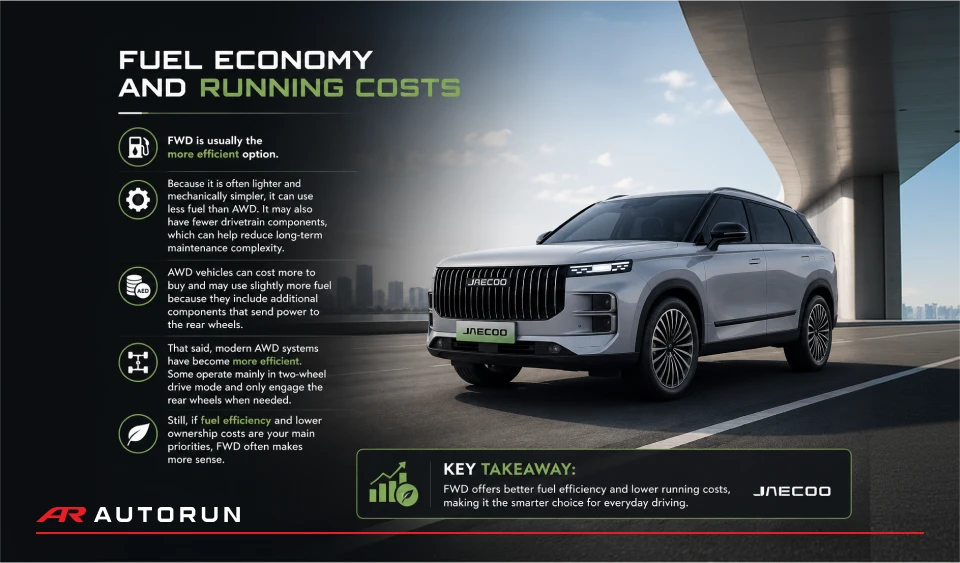
FWD usually has the advantage here.
An AWD system adds components and weight, which can increase fuel consumption and the purchase price.
AWD vehicles can also involve additional drivetrain components that may increase maintenance costs over the long term.
Modern AWD systems have become more efficient, and some disengage the rear axle when extra traction is not required. Even so, if your main priorities are fuel economy and lower running costs, FWD is usually the better choice.
Is AWD Safer Than FWD?
Not necessarily.
AWD can provide better traction when accelerating on slippery or loose surfaces, but overall safety depends on much more than drivetrain type.
Important factors include:
- Tyre quality
- Brakes
- Stability control
- Suspension
- Driver behaviour
- Road conditions
- Safe speed
AWD cannot overcome poor tyres or excessive speed.
For normal UAE city and highway driving, a well-equipped FWD vehicle with good tyres and modern safety systems can be perfectly suitable.
Choose FWD If…
FWD is likely the better option if:
- Most of your driving is in the city
- You mainly use paved roads and highways
- Fuel economy matters
- You want a lower purchase price
- You prefer simpler maintenance
- You rarely drive on loose or uneven surfaces
For many UAE drivers, FWD is the most sensible everyday choice.
Choose AWD If…
AWD may be worth paying extra for if:
- You frequently drive on gravel or uneven roads
- You visit campsites or outdoor areas
- You regularly travel on mountain routes
- You want extra traction during rain
- You drive a larger or more powerful SUV
- Your weekends often take you beyond normal paved roads
In these situations, AWD offers a practical advantage rather than simply being a higher specification.
What Should UAE SUV Buyers Check?
Before choosing between FWD and AWD, compare the complete vehicle rather than drivetrain alone.
Look at:
- Fuel consumption
- Ground clearance
- Tyre size and replacement cost
- Available drive modes
- Stability and traction control
- Service costs
- Warranty
- Trim-level differences
It is also worth taking a test drive. An AWD version may include other equipment that changes the overall driving experience, so compare the exact trims you are considering.

Final Thoughts
For most UAE drivers who spend their time commuting, shopping, and travelling on highways, FWD is usually the more practical and economical choice.
AWD makes more sense for drivers who regularly encounter gravel, uneven roads, wet conditions, outdoor routes, or light off-road terrain.
The important point is not to choose AWD simply because it sounds more capable.
Choose based on how you actually use the vehicle.
If your driving stays mostly on paved roads, FWD can save money without sacrificing everyday usability. If your weekends regularly take you away from the city and onto changing surfaces, AWD can be worth the extra cost.
FAQs
Is FWD or AWD better for driving in Dubai?
For most Dubai driving, FWD is usually enough. It is well suited to paved roads, highways, commuting, and everyday city use while generally offering better fuel economy.
Does AWD use more fuel than FWD?
Usually, yes. AWD systems add weight and drivetrain components, which can slightly increase fuel consumption. The exact difference depends on the vehicle and AWD system.
Is AWD better in UAE rain?
AWD can provide better traction when accelerating on wet roads, but it does not automatically shorten braking distances. Good tyres, safe speeds, and increased following distance remain more important.
Can an AWD SUV drive in the UAE desert?
AWD can handle light sand and some desert-adjacent tracks, but it is not automatically suitable for dune driving. Serious desert driving may require proper 4WD, suitable ground clearance, tyres, recovery equipment, and experience.
Is AWD the same as 4WD?
No. AWD is generally designed for everyday driving and changing road conditions, while 4WD systems are typically more focused on demanding off-road terrain.
Is AWD worth the extra cost in the UAE?
It can be if you regularly drive on gravel, mountain roads, campsites, or loose surfaces. If almost all your driving is in the city and on highways, FWD is often the more economical choice.
